
Published July 7, 2026
The "Walkability Tax": Why Downtown Naperville Access is Lowering Appraisals Just 10 Minutes Away

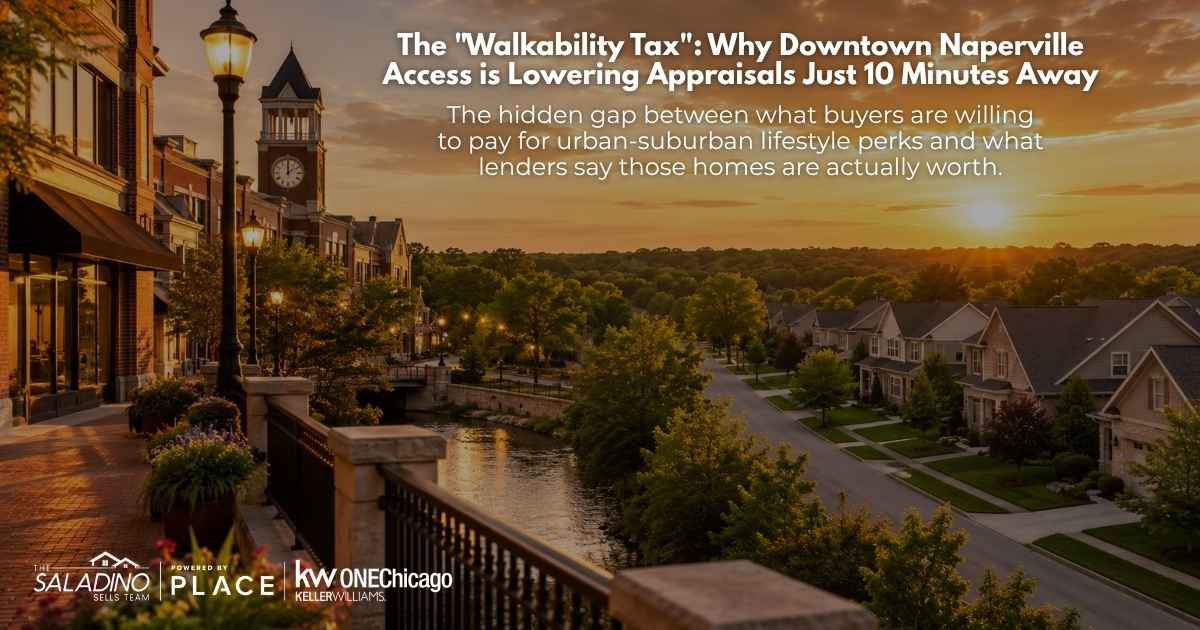
The hidden gap between what buyers are willing to pay for urban-suburban lifestyle perks and what lenders say those homes are actually worth.
If you’ve spent any time looking for a home in the western suburbs lately, you already know that Downtown Naperville is one of the most highly coveted locations in the entire Chicagoland area. From world-class dining along the Riverwalk to local boutiques and top-tier schools, buyers are willing to pay an absolute premium to be within walking distance of the action.But as the rush to capture this "urban-suburban" lifestyle reaches an all-time high, a quiet issue is surfacing just outside the core perimeter. At The Saladino Sells Team, we’re noticing a growing trend that we call the "Walkability Tax"—and it's causing sudden headaches for buyers, sellers, and agents during the appraisal process.
Here is how the hyper-focus on downtown access is skewing the numbers just ten minutes away.
Understanding the "Walkability Tax"
The concept is simple: buyers are putting a staggering monetary value on being able to leave their cars in the garage. They aren't just buying square footage; they are purchasing a lifestyle.The problem? Appraisal guidelines don't have a standardized metric for "lifestyle vibes."
When a buyer falls in love with a property that is a 5-minute walk to the local coffee shops, they might comfortably bid $50,000 to $75,000 over the asking price to win it in a competitive market. However, if a nearly identical home sits just a 10-minute drive away—in a beautiful, quiet neighborhood but completely reliant on a car—the market value behaves entirely differently.
The Appraisal Disconnect: Real estate appraisers rely on cold, hard data: historical sales data, square footage, bedroom counts, and strict geographical radii. They look at what a house is, while emotional buyers look at where a house takes them.
How 10 Minutes Can Lower Your Appraisal
When an appraiser pulls recent sales ("comps") to justify a purchase price, they are bound by guidelines set by lenders and secondary market giants like Fannie Mae. This creates a collision course for homes sitting just outside the downtown core.Here is exactly how the 10-minute radius creates a valuation slide:
- The Geographical Boundary Trap: Appraisers prefer comps within a 1-mile radius. If your home is 10 minutes outside of Downtown Naperville, the appraiser might have to use homes in your immediate subdivision rather than the high-flying sales closer to the city center.
- Subdivision Sub-Markets: Neighborhoods further out have their own micro-market dynamics. While a downtown home might fetch $500 per square foot because of its location, a home 10 minutes away might top out at $320 per square foot based on historic neighborhood ceilings.
- The Over-Adjustment Factor: If an appraiser does pull a comp from Downtown Naperville to use for a suburban neighborhood property, they will apply massive downward location adjustments. These adjustments often overcorrect, dragging down the calculated value of the home that is just a short drive away.
What This Means for Buyers and Sellers
If you are navigating the Naperville market right now, you have to factor the walkability gap into your real estate strategy.For Sellers Just Outside Downtown:
Do not assume that the record-breaking sale three blocks from the Riverwalk means your home value just jumped by the same amount. To protect your sale, your pricing strategy needs to be anchored in your immediate neighborhood's data. If you get a hyper-aggressive offer from a buyer who missed out on a downtown property, be prepared for a potential appraisal shortfall and make sure your agent negotiates strong appraisal gap coverage in the contract.For Buyers Chasing the Periphery:
Buying 10 minutes away from downtown is a fantastic way to get more square footage, a larger yard, and a lower purchase price. However, if you are bidding aggressively on a peripheral home because you view it as "practically downtown," remember that the bank’s appraiser will view it strictly as a suburban property. Keep emergency capital on hand to cover a low appraisal if you plan to bid well over market value.Navigating the Sub-Markets with Experts
The Naperville real estate market isn't a monolith—it is a collection of micro-markets that change block by block. Bridging the gap between emotional market demand and rigid appraisal math requires a team that tracks these hyper-local shifts every single day.Whether you are trying to maximize your equity on a sale or ensure you aren't overpaying as a buyer, we can help you decode the numbers.

Michael Saladino
Managing Broker | Saladino Sells Team | Keller Williams ONEChicago | PLACE
or another way