
Published July 8, 2026
The AI Hum Next Door: How Massive New Data Centers Are Quietly Rattling Home Values in Far East Aurora

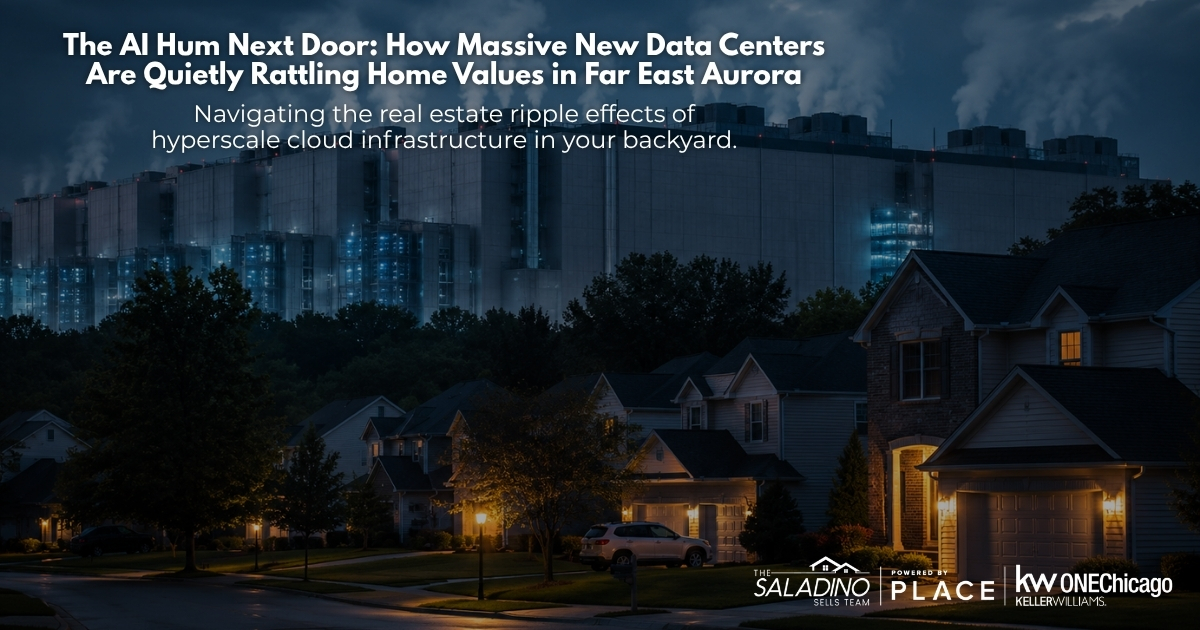
Navigating the real estate ripple effects of hyperscale cloud infrastructure in your backyard.
If you take a quiet evening walk through certain neighborhoods in Far East Aurora, you might notice something new in the air. It isn't the rustle of the prairie wind or distant traffic on the Parkway. Instead, it’s a faint, continuous, low-frequency hum—the sound of thousands of cooling fans keeping the engines of the artificial intelligence boom from overheating.
As tech giants race to build the infrastructure required to power our increasingly digital lives, Far East Aurora has quietly become a major frontline. With massive infrastructure investments—like the expanding QTS Data Centers facility on Gun Club Road—this tech boom is transforming localized spaces.
But while municipal leaders look at multi-million dollar property tax windfalls, local homeowners are left asking a crucial question: What is this tech footprint actually doing to my property value?
At The Saladino Sells Team, we believe in tracking the data closely so our clients are never caught off guard. Let’s break down the hidden realities of living near a hyperscale data center and what it means for your real estate equity.
Furthermore, these structures are massive—often covering the equivalent of multiple football fields—altering the suburban aesthetic and residential character that originally drew buyers to Far East Aurora. When a home hits the market right next to a facility, buyers often demand a price concession to compensate for their new industrial neighbor.
Data centers pay millions in local property taxes. In neighboring districts, these funds have directly financed brand-new school constructions, road expansions, and fortified utility grids without raising individual household tax rates. Furthermore, the high-paying engineering and security teams working at these hubs look for short commutes, creating a localized "employment catchment" that pulls home values upward.
If you take a quiet evening walk through certain neighborhoods in Far East Aurora, you might notice something new in the air. It isn't the rustle of the prairie wind or distant traffic on the Parkway. Instead, it’s a faint, continuous, low-frequency hum—the sound of thousands of cooling fans keeping the engines of the artificial intelligence boom from overheating.
As tech giants race to build the infrastructure required to power our increasingly digital lives, Far East Aurora has quietly become a major frontline. With massive infrastructure investments—like the expanding QTS Data Centers facility on Gun Club Road—this tech boom is transforming localized spaces.
But while municipal leaders look at multi-million dollar property tax windfalls, local homeowners are left asking a crucial question: What is this tech footprint actually doing to my property value?
At The Saladino Sells Team, we believe in tracking the data closely so our clients are never caught off guard. Let’s break down the hidden realities of living near a hyperscale data center and what it means for your real estate equity.
The Proximity Matrix: How Close is Too Close?
When it comes to data centers, real estate impact is entirely a game of inches and miles. National real estate studies and recent localized trends show a sharp divide in how property values react based on exactly how close a home sits to a facility.The Real Estate Proximity Impact Framework
| Distance from Facility | Primary Impact | Average Value Impact |
| 0 to 500 Feet | High visual footprint; continuous cooling noise (55–65 dB). | Discount of 5% to 15% |
| 500 Feet to 0.25 Miles | Moderate visual footprint; variable low-frequency hum. | Discount of 2% to 7% |
| 0.5 to 2 Miles | No noise or visual impact; benefits from civic infrastructure. | Premium of +1% to +4% |
| 2+ Miles | Neutral baseline; standard market appreciation applies. | Market Neutral |
The Adjacency Discount vs. The Neighborhood Premium
As the table highlights, the impact of these massive tech hubs is double-edged.1. The Immediate Adjacency Discount
For homes built directly against or within a quarter-mile of these industrial complexes, the immediate impact is often a valuation discount. Data centers operate 24/7/365. The massive industrial chillers and backup diesel generators create an acoustic footprint that can affect backyard enjoyability.Furthermore, these structures are massive—often covering the equivalent of multiple football fields—altering the suburban aesthetic and residential character that originally drew buyers to Far East Aurora. When a home hits the market right next to a facility, buyers often demand a price concession to compensate for their new industrial neighbor.
2. The Infrastructure Sweet Spot
Conversely, if your home is sitting half a mile to two miles away, the outlook changes entirely. At this distance, the noise and visual impact drop to zero, but your property still reaps the macroeconomic benefits.Data centers pay millions in local property taxes. In neighboring districts, these funds have directly financed brand-new school constructions, road expansions, and fortified utility grids without raising individual household tax rates. Furthermore, the high-paying engineering and security teams working at these hubs look for short commutes, creating a localized "employment catchment" that pulls home values upward.
The Saladino Sells Takeaway: A data center isn't an automatic death sentence for property values, nor is it a guaranteed lottery ticket. It’s a localized variable. If you are buying or selling in Far East Aurora, knowing the future zoning maps and expansion phases of these tech parks is non-negotiable.
What Should Far East Aurora Homeowners Do Next?
If you currently own a home or are looking to move into the Far East Aurora corridor, here is your action plan:- Check the Zoning Maps: Data centers require massive power and water access. Keep a close eye on the city’s mixed-use and light-industrial zoning boundaries near your neighborhood.
- Verify the Cooling Technology: Newer data centers are increasingly moving toward liquid cooling or advanced architectural sound barriers to suppress ambient noise. If a center is planned near you, advocate at community planning meetings for strict decibel caps.
- Consult a Local Expert: Traditional online home valuation algorithms don't know a data center is being built down the street. They look only at past sales, meaning they can lag behind real-time market shifts.

Michael Saladino
Managing Broker | Saladino Sells Team | Keller Williams ONEChicago | PLACE
or another way