
Published July 24, 2026
The Downtown "Land Assembly" Arbitrage: How City Parcel Buyouts Near Lee & Miner Streets Are Silently Repricing Des Plaines Walkable Homes

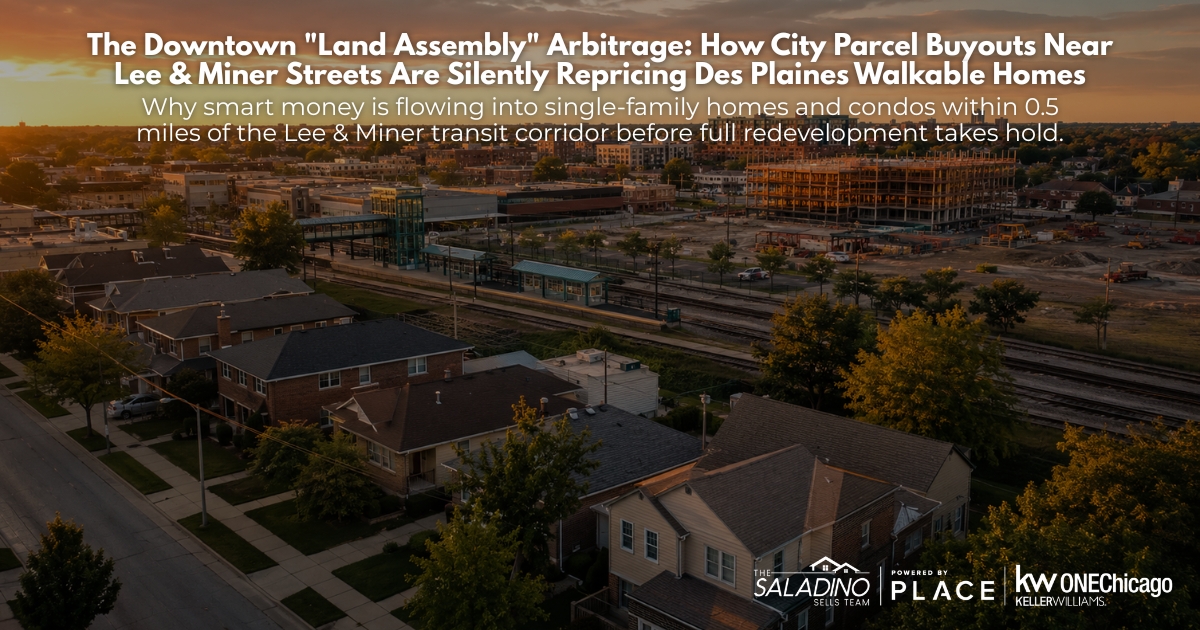
Why smart money is flowing into single-family homes and condos within 0.5 miles of the Lee & Miner transit corridor before full redevelopment takes hold.
If you have walked through Downtown Des Plaines recently near the corner of Lee Street and Miner Street (IL-14), you’ve likely noticed the subtle shifts. What looks like routine municipal upkeep or commercial property transitions is actually part of a larger, deliberate economic strategy: municipal land assembly and Transit-Oriented Development (TOD).From the City’s strategic acquisition of key downtown parcels (such as 620 Lee Street) to multi-million-dollar revitalizations around the historic Des Plaines Theatre and Metropolitan Square, municipal leadership is systematically assembling underutilized real estate.
For property owners, homebuyers, and real estate investors in Des Plaines, this creates a classic market dynamic known as land assembly arbitrage.
What Is "Land Assembly Arbitrage" in Real Estate?
Land assembly arbitrage occurs when a municipality or private developer quietly acquires individual adjoining parcels of land over time to create a larger, high-density site for future mixed-use development.When a city drives or facilitates parcel buyouts around major commuter corridors—like the Lee and Miner intersection adjacent to the UP-NW Metra Station—two key market forces occur:
- Commercial Land Values Spike: Aggregated parcels become far more valuable to high-density developers than the sum of their individual commercial parts.
- Adjacent Residential Values Are Repriced: Homes, townhomes, and condos within a 5-to-10-minute walk (0.25 to 0.5 miles) experience an uptick in demand as walkability, retail density, and transit convenience expand.
Why the Lee & Miner Corridor Is the Catalyst
The intersection of Lee and Miner Streets sits at the geographical and historic heart of Des Plaines commerce. Historically dominated by legacy single-story retail and service spaces, this micro-zone is undergoing a modern transformation focused on walkability.The Transit-Oriented Development (TOD) Value Chain:
- UP-NW Metra Train Station
- Walkable Radius (0.25 to 0.5 Miles)
- Walkable Radius (0.25 to 0.5 Miles)
- Lee & Miner Intersection
- Des Plaines Theatre & Entertainment District
- Municipal Parcel Buyouts & Strategic Investments
- Metropolitan Square & Mixed-Use Retail
- Des Plaines Theatre & Entertainment District
- Surrounding Housing Stock
- Single-Family Homes, Townhomes, and Walkable Condominiums
- Result: Increasing buyer demand and steady, silent equity growth
- Single-Family Homes, Townhomes, and Walkable Condominiums
The Ripple Effect on Walkable Residential Homes
When cities convert low-density commercial plots into vibrant mixed-use residential and retail spaces, neighboring residential properties gain substantial passive equity:- The Walkability Premium: Modern suburban buyers—especially commuters heading into Chicago or O'Hare—are willing to pay a premium for homes where they can walk to the train, grab dinner, and hit a show at the Des Plaines Theatre without touching a car key.
- Density Caps & Inventory Scarcity: As land right in the core gets reconfigured for commercial or multi-family use, surrounding single-family zoning becomes increasingly finite. High demand combined with capped single-family supply creates upward pricing pressure.
- Infrastructure & Aesthetic Upgrades: Municipal investment inevitably brings upgraded streetscapes, ADA-accessible sidewalks, improved traffic signals, and refreshed public parking—enhancing the overall curb appeal of the surrounding neighborhoods.
How to Capitalize on the Shift
For Current Des Plaines Homeowners
If you own a single-family home, townhome, or condo within a few blocks of Miner Street, Lee Street, Graceland Avenue, or Prairie Avenue, your equity profile may have shifted without your realizing it. Standard automated online home valuation tools often miss hyper-local, block-by-block municipal development trends.For Homebuyers & Investors
Waiting until major multi-use developments are fully built out often means paying peak market prices. Identifying homes in walkable pockets near downtown Des Plaines during the assembly phase allows buyers to lock in purchase prices before the full commercial amenity base is active.Key Metrics to Watch in Downtown Des Plaines
When analyzing properties near the Lee & Miner corridor, keep an eye on these indicators:| Indicator | Market Impact | Why It Matters |
| Transit Proximity | High | Distance to the Des Plaines Metra station directly influences rental rates and resale velocity. |
| City Council Zoning Agendas | High | Zoning changes from commercial (C-2/C-3) to transit-oriented development (TOD) indicate incoming investment. |
| Days on Market (DOM) | Medium | Walkable homes near downtown typically absorb faster than homes in outlying suburban subdivisions. |
| Price per Square Foot Trends | High | Tracks how downtown core pricing diverges from broader Cook County averages over time. |
Navigate Des Plaines Real Estate with Local Experts
Understanding complex market mechanics like land assembly, zoning shifts, and transit-oriented re-pricing requires deep hyper-local expertise.At The Saladino Sells Team, we pair data-driven market analysis with hands-on local knowledge to help buyers, sellers, and investors make informed real estate decisions across Des Plaines and Chicagoland.
Thinking about selling, buying, or investing near Downtown Des Plaines?
Contact The Saladino Sells Team today for a personalized, hyper-local equity analysis and market forecast for your property.

Michael Saladino
Managing Broker | Saladino Sells Team | Keller Williams ONEChicago | PLACE
or another way