
Published June 25, 2026
The Secret Language of Chicago Brick: Spotting Hidden Structural Nightmares Before Buying a Vintage North Side Two-Flat

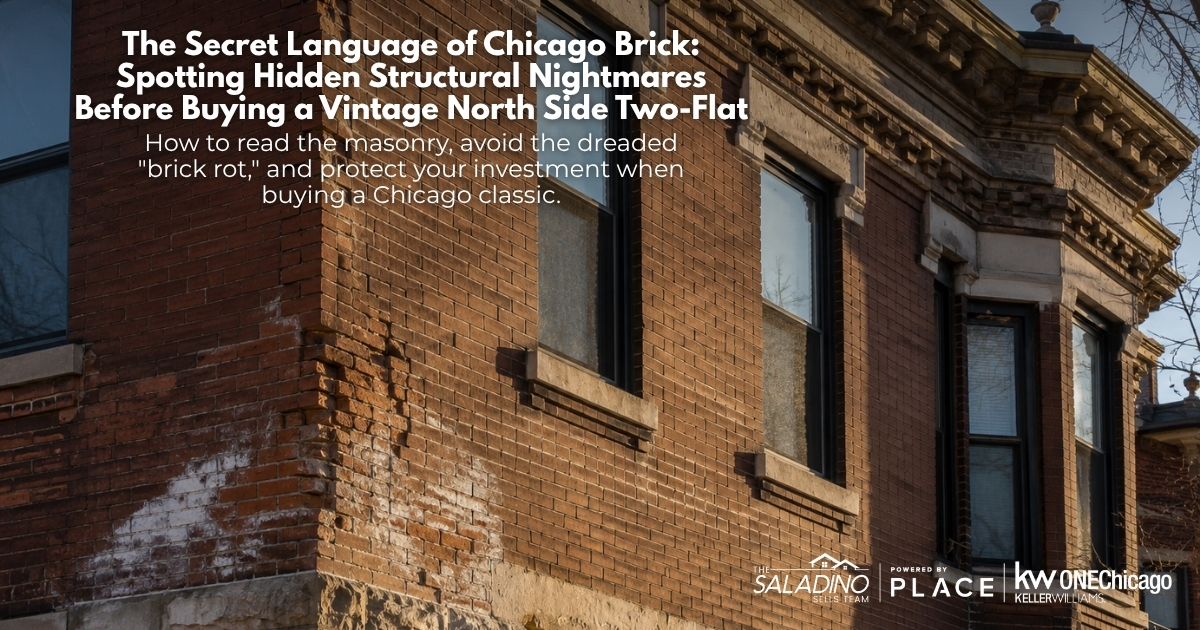
How to read the masonry, avoid the dreaded "brick rot," and protect your investment when buying a Chicago classic.
There is nothing quite like the charm of a classic North Side Chicago two-flat. From the tree-lined streets of Lincoln Square to the historic stretches of Lakeview and Logan Square, these buildings are the literal backbone of our city. They represent a timeless investment, a piece of history, and a fantastic way to break into the Chicago market.
But here is the truth that every buyer needs to hear: vintage brick has a language of its own. If you don't know how to read it, that beautiful brick facade can hide structural nightmares that will drain your bank account faster than a winter blizzard. At The Saladino Sells Team, we believe in falling in love with a property with your eyes wide open.
Before you sign on the dotted line for that vintage multi-family, here is how to decode Chicago masonry and spot the red flags.
This is called spalling, colloquially known as brick rot.
The nightmare occurs when a well-meaning (but uneducated) DIYer or a cheap flipper slaps modern Portland cement over vintage lime mortar during a tuckpointing job.
A bulging or bowing wall is an absolute structural emergency. It usually indicates that:
Over time, if water gets behind the brick, these steel lintels will rust. When steel rusts, it expands (a phenomenon known as "rust jacking"). This expansion exerts massive upward pressure on the brickwork, causing a classic stair-step cracking pattern moving upward and outward from the corners of the windows.
If left unaddressed, the brick above the window can completely collapse, taking the window frame and the interior wall with it.
The key is working with an experienced real estate team that knows how to spot these red flags before you pay for a formal home inspection. At The Saladino Sells Team, we’ve walked hundreds of vintage Chicago basements, gangways, and alleys. We know what a healthy building looks like—and we know exactly when to tell you to run.
Thinking about buying a piece of Chicago history?
There is nothing quite like the charm of a classic North Side Chicago two-flat. From the tree-lined streets of Lincoln Square to the historic stretches of Lakeview and Logan Square, these buildings are the literal backbone of our city. They represent a timeless investment, a piece of history, and a fantastic way to break into the Chicago market.
But here is the truth that every buyer needs to hear: vintage brick has a language of its own. If you don't know how to read it, that beautiful brick facade can hide structural nightmares that will drain your bank account faster than a winter blizzard. At The Saladino Sells Team, we believe in falling in love with a property with your eyes wide open.
Before you sign on the dotted line for that vintage multi-family, here is how to decode Chicago masonry and spot the red flags.
1. The Tale of Two Bricks: Face Brick vs. Chicago Common
To understand a two-flat, you have to understand the anatomy of its walls. Chicago buildings of the late 19th and early 20th centuries typically used two completely different types of brick:- Face Brick (The Front): This is the hard, durable, weather-resistant, and aesthetically pleasing brick on the street-facing side of the building. It was built to withstand the elements and look good doing it.
- Chicago Common Brick (The Sides and Back): Made from local Cook County clay, these iconic, salmon-pink bricks are much softer and highly porous. Because they were cheap to produce, they were used for the sides and rear of the building.
The Risk: Because Chicago Commons are porous, they absorb water like a sponge. If the building’s gutters, coping stones, or drainage systems fail, those side walls will deteriorate rapidly.
2. Red Flag: The Dreaded "Brick Rot" (Spalling)
When you walk the exterior of a two-flat, look closely at the surface of the bricks on the side and back walls. Do they look like they are peeling, flaking, or popping off?This is called spalling, colloquially known as brick rot.
[ Water Trapped Inside Brick ] ➔ [ Freezes & Expands ] ➔ [ Brick Face Pops Off / Crumbles ]
3. Red Flag: The Danger of "Sand Lime" Mortar and Bad Tuckpointing
Vintage two-flats were built using traditional lime-and-sand mortar, which is soft and flexible. This allowed the building to breathe and shift slightly with the changing seasons.The nightmare occurs when a well-meaning (but uneducated) DIYer or a cheap flipper slaps modern Portland cement over vintage lime mortar during a tuckpointing job.
- Why it’s a disaster: Portland cement is incredibly hard and waterproof. When the building tries to shift or moisture tries to escape, the hard modern cement traps the water inside the soft vintage brick. Instead of the mortar wearing away over time (which it is supposed to do), the brick itself cracks and crushes under the pressure.
4. Red Flag: Bulging or "Bowing" Brick Walls
Stand at the corner of the building, press your cheek near the wall, and look straight down the sightline of the side facade. Is it perfectly straight, or does it look like it has a "belly"?A bulging or bowing wall is an absolute structural emergency. It usually indicates that:
- The inner and outer wythes (layers) of brick have separated.
- Water has rusted out the iron or steel structural ties holding the walls together.
- The foundation is shifting unevenly.
5. Red Flag: Rusting Lintels and "Step Cracking"
Look above the windows and doors of the two-flat. You’ll see heavy steel or iron beams spanning the openings—these are lintels, and they hold up the massive weight of the brick above the window.Over time, if water gets behind the brick, these steel lintels will rust. When steel rusts, it expands (a phenomenon known as "rust jacking"). This expansion exerts massive upward pressure on the brickwork, causing a classic stair-step cracking pattern moving upward and outward from the corners of the windows.
If left unaddressed, the brick above the window can completely collapse, taking the window frame and the interior wall with it.
The Vintage Two-Flat Masonry Checklist
Before making an offer, take this quick checklist with you to your North Side showing:| Structural Area | What to Look For | Risk Level |
| Parapet Walls (Roofline) | Loose coping stones, cracked mortar at the very top of the building. | High (Primary source of water intrusion) |
| Side Facades | Spalling (flaking) Chicago common bricks; powdery residue. | Medium to High (Sign of ongoing moisture issues) |
| Sightlines | Bulges, waves, or "bellies" in the brickwork. | Critical (Potential structural collapse) |
| Window Headers | Rusted, unpainted steel lintels with diagonal step-cracking. | High (Requires immediate lintel replacement) |
| Ground Level | Mortar completely washed away near the dirt or concrete line. | Medium (Requires localized tuckpointing) |
How to Protect Your Investment
Does a masonry issue mean you should walk away from your dream North Side two-flat? Not necessarily. In Chicago’s competitive real estate market, knowledge is leverage. If you spot these issues early, you can use them to negotiate the purchase price down, request credits at closing, or ensure you budget correctly for future remediation.The key is working with an experienced real estate team that knows how to spot these red flags before you pay for a formal home inspection. At The Saladino Sells Team, we’ve walked hundreds of vintage Chicago basements, gangways, and alleys. We know what a healthy building looks like—and we know exactly when to tell you to run.
Thinking about buying a piece of Chicago history?

Michael Saladino
Managing Broker | Saladino Sells Team | Keller Williams ONEChicago | PLACE
or another way